Friday, September 16, 2011

Konda Kawda - Sri Lanka Drongo (Dicrurus lophorinus)


Identification


  • Black plumage with metallic blue or greenish-blue gloss
  • Arching, helmet-like crest
  • Deeply forked tail
  • Red eye
  • Sexes similar

Behavior

Forest , forest edges, plantations, wooded gardens.
Like most drongos, hawks after insects from open perches.
A superb mimic of the calls of other birds but always has a metallic sound.

Gallery


Pita Rathu Batagoya - Sri Lankan Green Pigeon (Treron pompadora)


Identification

Sri Lankan Green pigeon is approximately 26-30 cm in length. The head, tail and underparts are bright green, with a grey crown to the head. The legs are red and the bill is thin and grayish. The flight feathers and tail are blackish. The male has a chestnut back, usually uniform. The female has a bright green back and lacks the orange on the breast.

Behavior

This is a common species in rainforest and similar dense wet woodlands. It builds a stick nest in a tree and lays two white eggs.  Pompadour Green pigeons usually occur singly or in small groups. They eat the seeds and fruits of a wide variety of plants.

Gallery


Paduwan Bassa - Serendib Scops Owl (Otus thilohoffmanni)


Identification

The new species is a small scops owl about 17 cm in length, with a short tail, and almost uniformly rufescent upperparts but for the presence of small black spots all over the body. The face is a little darker, and underparts paler than upper parts, with the belly becoming whitish. It has no distinct, “true” ear-tufts, but see below. The irides are orange-yellow in the male and yellow in the female and juvenile. The beak, legs and claws are whitish. The legs are feathered on the tibia and upper tarsi. The vocalization comprises a single note, pu’u’u, repeated at long intervals. Male and female call in the same pattern but in different keys.

Behavior

At the time of the type description we knew that birds of a pair roosted fairly close together or well apart within their territory. Later we learnt that in some pairs the birds roost together or very close. A fledgling has been observed roosting with an adult male. Roosting height varies from about 1 to 2.5 m. A well-concealed place is chosen in dense vegetation in the undergrowth or just above it. Here the bird sits on an almost or entirely horizontal twig, usually close to dead leaves. Its size, shape and coloration blend it in perfectly with the surroundings, making it hard to detect. When an owl is in “alert mode” at its daytime roost, in reaction to possible danger in the vicinity, it quickly adopts a stance which disguises it as a short, upright, broken branch. It tightens body feathers, which are otherwise loose and relaxed, to acquire a narrower appearance. At the same time it adjusts the feathers of the facial disk, forehead and crown to give the appearance of the top of such a branch. This latter arrangement is adopted also by species of owl which have two obvious, separate ear-tufts, which are erected to enhance this effect. The Serendib Scops Owl, which does not possess ear-tufts, achieves a similar effect by compressing and flattening feathers on the forehead, forecrown and sides of the facial disk, and folding feather tracts on the forehead at the edges of the disk over the inner part of the eyes. This makes the top left and right edges of the disk stand out, with also the support of adjacent crown feathers, giving an impression of short ear-tufts. Another result is an obvious, broader and deeper V on the forehead, showing up more white, than in a bird in “relaxed mode”. At night the Serendib Scops Owl adopts this “pseudo-eartuft” arrangement only very rarely, according to our observations, probably because there is no significant advantage of such visual camouflage in the dark. It has been known that in similar situations species of owls lacking true ear-tufts adopt a camouflage pose which suggests the presence of small ear-tufts.

Location

Endemic to Sri Lanka, found thus far only in the southwest quarter of the island at Kitulgala, Kanneliya and Eratna-Gilimale Reserves, with its strongholds in the Sinharaja and Morapitiya-Runakanda reserves, which are contiguous.

Gallery


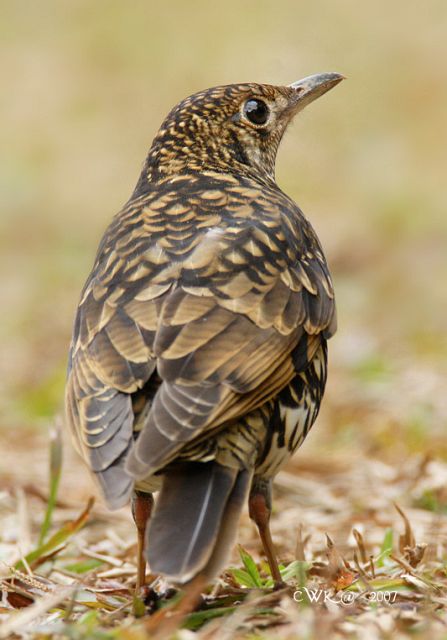
Pethi Gomara Wal Awichchiya - Ceylon Scaly Thrush (Zoothera dauma imbricata)


Between a mynah and a bulbul in size. Identified by its olive-brown upper parts, two rows of white spots on the median and greater wing coverts, characteristic markings on the face and inverted fan shaped black spots on the breast and flanks. Sexes are similar. Young have paler streaked upper parts and buff lower parts with coalescing spots. The characteristic facial pattern is present in the young but is more indistinct.
 Not uncommon in damp, evergreen forest in the wet lowlands and ranging up to 2000 metres (commoner below 1500 metres). Also occurs in secondary scrub, plantations and occasionally gardens adjacent to forest. It is scarce and local in the dry zone occurring in riverine forests.
This is a terrestrial species which feeds mostly on the ground in the typical thrush manner, turning over leaves vigorously. Birds are often met with in the mornings and evenings feeding along jungle trails. This thrush has a quaint habit of perching on slight elevations or twigs on the ground. The Spotted-winged Thrush is a beautiful songster, singing with a variety of human sounding rich whistling notes. It also utters a thin, high pitched call when alarmed or as a warning to its mate. Food consists of insects, worms etc but the bird probably feeds on berries as well.

Behavior

This is a terrestrial species which feeds mostly on the ground in the typical thrush manner, turning over leaves vigorously. Birds are often met with in the mornings and evenings feeding along jungle trails. This thrush has a quaint habit of perching on slight elevations or twigs on the ground. The Spotted-winged Thrush is a beautiful songster, singing with a variety of human sounding rich whistling notes. It also utters a thin, high pitched call when alarmed or as a warning to its mate. Food consists of insects, worms etc but the bird probably feeds on berries as well.
The species is double brooded. Nests are met with in March-April and again in August-November. The nest is generally placed in a low exposed fork of a sapling or small tree at a height from 4-8 feet within the forest. The nest looks like a mass of jungle debris collected in a fork comprising of dead and decaying leaves, stems etc with a small tolerably neat cup in the center lined with fine rootlets and leaf midribs. The rim is often finished with moss. Where moss is plentiful more of it is used in the construction of the nest.
The eggs are generally two in number. The ground colour varies from pale cream-buff to pale grey-green, profusely covered with small spots, blotches and streaks of light reddish brown all over with some underlying markings of lavender-pink. Both birds probably incubate and feed the young.   

Gallery


Wana Kowulaspatiya - Ceylon Wood Shrike (Pondicerianus affinis)


The Ceylon Woodshrike is a nondescript, sparrow sized bird of mostly grey plumage. The male has a dark mask across the eye. A prominent feature which stands out in this drab plumage is a white rump bordered below with black upper tail coverts. The female is browner with a less prominent mask. The Wood Shrike is a common bird in the low country dry zone and ascends the hills to about 1200 metres especially on the dryer, eastern side. It is scarce and local in the wet zone.
It usually moves about in pairs frequenting scrub as well as large trees flitting about looking for the insects on which it feeds. The Wood Shrike generally avoids heavy forest. The bird would hardly be noticed if not for its distinctive, pleasant call which sounds like ‘ twee-twee-twee-twee, twy, twy, twy, twy ’ uttered rapidly on a descending scale.

Behavior

The Ceylon Wood Shrike breeds during the early part of the year building a well camouflaged small cup like nest stuck to the top of a horizontal branch or in a fork between two smaller branches. The nest is very difficult to spot unless the sitting bird is seen as it is well covered on the outside with cobweb and flakes. The young too are obliteration coloured to resemble a lichen covered excrescence of a branch and are very difficult to spot. The nest is generally placed about 3 to 5 metres from ground level. The two to three eggs are buff or greenish white in ground colour blotched all over with purplish-grey and brown.

Gallery